
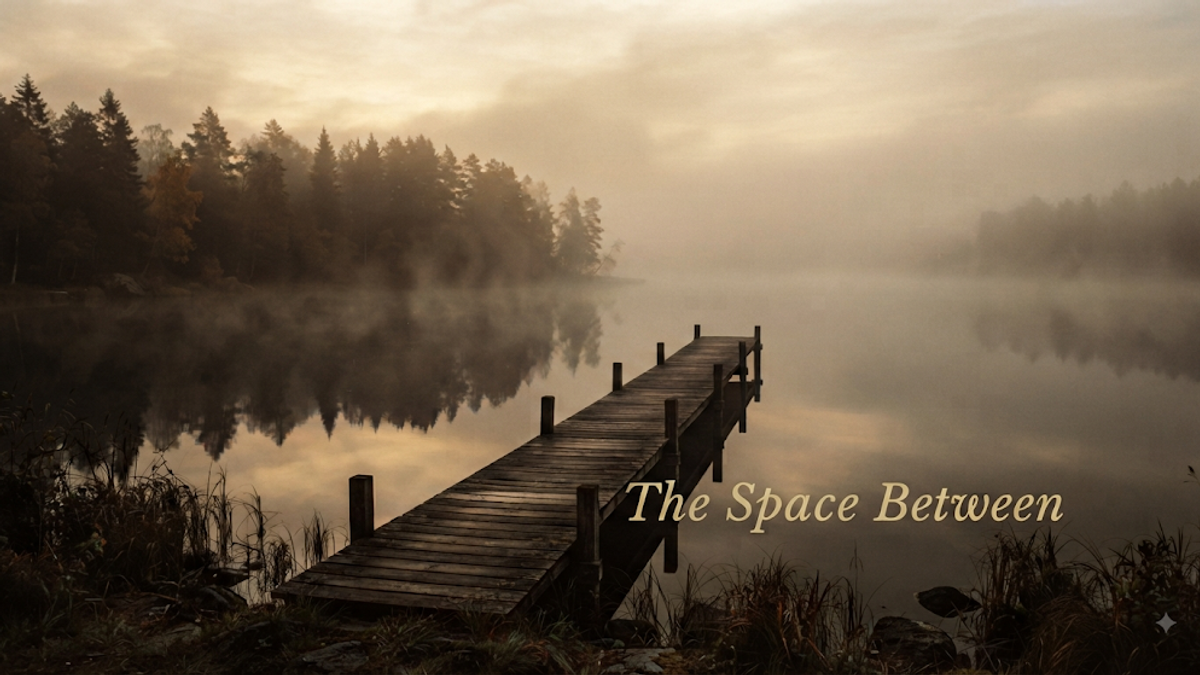
The Space Between...
What Happens When We Stop Trying to Fix People
Over the years, I’ve spent a lot of time looking for answers.
I’ve experienced therapy from the client’s chair. I’ve studied CBT, NLP and hypnosis, listened to countless books, and spent time around Buddhist monasteries and teachers.
Somewhere amongst all that learning, something rather inconvenient occurred to me:
Perhaps knowing more isn’t always the answer.
Years ago, I was at Samye Ling listening to Ringu Tulku Rinpoche speak about Buddhism in everyday life. During a discussion, someone began sharing what they knew, quoting teachings and ideas one after another before eventually presenting their conclusion to Rinpoche.
He listened.
Then simply said:
“Is it?”
No correction. No argument. No demonstration of superior knowledge.
Just two words — and space.
I remember watching what happened. Certainty suddenly had somewhere to go other than forward.
Rinpoche told another story that has stayed with me. When staying somewhere as a guest, he would sit quietly each day in a beautiful room. Outside his window lived a peacock.
The peacock, apparently, had impeccable timing.
Just as his mind began to settle and stillness arrived, it would squawk.
Loudly.
What stayed with me wasn’t the peacock. It was Rinpoche describing how he noticed his own frustration.
Years of practice hadn’t removed the irritation. The practice was noticing what arose when the peacock inevitably squawked.
I think about that when working with people.
When somebody tells us they’re struggling, our own internal peacock can become surprisingly noisy.
We want to help. We search for the right question. We reach for our training. We spot patterns, formulate explanations, reassure, reframe and advise.
All with good intentions.
But whose need are we satisfying in that moment?
Theirs — or ours?
During my NLP Master Practitioner training, Michael Breen once asked the room what we thought being a “master practitioner” meant.
Knowledge? Skill? Experience? Mastery of technique?
His answer was much simpler:
A master practitioner is someone who practises more.
That idea has followed me around ever since.
Perhaps the real practice isn’t accumulating enough knowledge to know what another human being needs. Perhaps it is becoming comfortable enough with ourselves that we don’t always need to know.
That changes questioning, too.
Socratic questioning needn’t be an interrogation dressed up as therapy. A good question can simply turn someone’s attention, gently, towards something they hadn’t noticed.
And then we get out of its way.
Sometimes the most useful thing we can offer another person is enough space to hear themselves think.
That doesn’t mean doing nothing. Nor does it mean withdrawing.
It means being completely present without needing to take control.
It means resisting the temptation to rescue, to demonstrate what we know, to fill every silence, or to push somebody towards the answer we’ve quietly decided they ought to discover.
And perhaps that is the space between.
I’m still practising it. I suspect I always will be.
But it leaves me with questions I increasingly value more than answers:
What might happen if I could quieten my own noise a little more?
Who might I hear differently?
Who might I help differently?
How might I live differently?
And what might become visible when we finally become quiet enough to see?

Richard Elwell
Executive & Leadership Clarity Guide with over 20 years of experience helping leaders, teams, and individuals find quiet clarity.
Ready to find quiet clarity in your decisions?
Book a 1-on-1 guided clarity session with Richard Elwell using the visual card process.