
The Classroom Changed. The Game Didn’t.
I don’t remember very much about my early years at school.
What I do remember is being frightened.
This was the mid-1960s. I was one of the children born into the post-war baby boom, and there were lots of us. Classrooms were full. Schools were busy. And I’m not sure there was a great deal of time for wondering why one particular little boy wasn’t quite managing to fit into the machinery.
And I desperately wanted to fit in.
I wanted to be liked. I wanted friends. I wanted to know whatever it was that everybody else seemed to know about how you were supposed to behave in this strange world I’d found myself in.
Looking back at that little boy now, I can almost see what some of the other children must have seen.
He was nervous. Gentle. Frightened of getting things wrong. Desperate to be accepted.
If you were looking for somebody to tease, I probably looked like a fairly safe bet.
There were children who had already begun to understand something about status. You could gain your place by being funny, being clever, being good at sport.
Or you could gain it by being harder than somebody else.
And if you needed somebody else to be lower down the ladder so that you could move yourself up it, I must have looked like a victim waiting to happen.
The more I wanted to fit in, the harder I tried.
And perhaps the harder I tried, the more obvious it became that I didn’t.
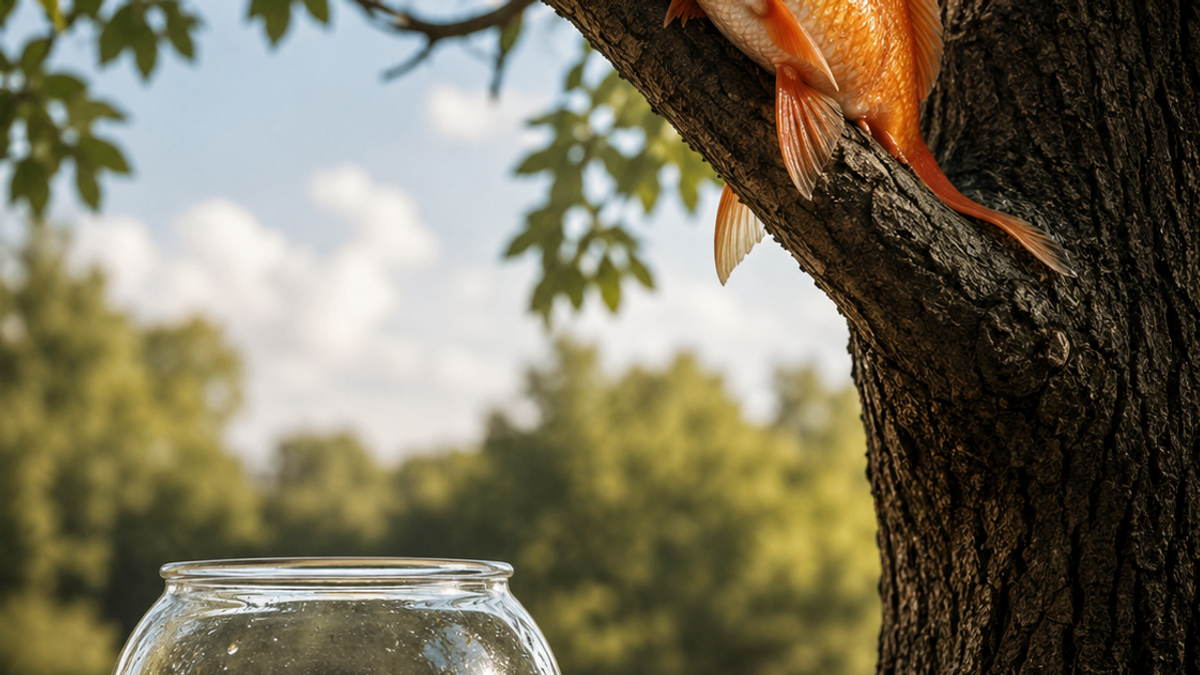
There is that familiar idea that you shouldn’t judge a fish by its ability to climb a tree.
Well, I was definitely a goldfish stuck halfway up one.
And everybody else appeared to be climbing.
One of the places this became painfully obvious was writing.
I mirror wrote.
For anyone who hasn’t come across that, I wrote backwards. Put a mirror against what I’d written and apparently it looked perfectly normal.
This was the 1960s.
The solution was wonderfully straightforward.
Put the pen in his other hand and see what happens.
So I was taught to write with my left hand.
There had been some suggestion that perhaps I should see a psychologist to understand what was going on. My parents didn’t think that was necessary.
And that was that.
Except, of course, I still had to write.
I remember sitting in an English lesson towards the end of junior school, desperately trying to make my handwriting look like everybody else’s.
I used to watch the girls writing.
They seemed to skip across the page like butterflies across a field. Beautiful handwriting. Pages of it.
Meanwhile, I was wrestling with a bloody pen.
Being left-handed didn’t help. In those days we wrote with ink, and as my hand travelled across the page my little finger and ring finger followed behind, smudging what I’d just written.
Some left-handed people learnt to turn the page or curl their hand around so they weren’t dragging it through the ink.
I didn’t.
I just tried harder.
And I really did try.
That particular day I managed about a paragraph.
Around me, other people had written a page and a half, perhaps two pages.
But I remember looking at mine and feeling proud.
Not because it was beautiful.
It wasn’t.
I would have made an amazing doctor if handwriting had been the entrance qualification.
I was proud because I knew how hard I had worked to produce that paragraph.
Then the teacher walked behind me.
He looked at the page.
And in front of the whole class he called out:
“Elwell. That looks like the last dying moments of a spider as it crawled from one page to the other.”
Everybody laughed.
Of course they did.
It was funny.
Unless you were the spider.
I don’t remember what happened for the rest of that lesson.
What I remember is the shame.
Because the thing they were laughing at was my best.
I couldn’t have tried harder.
And somehow my best was still so desperately not good enough.
I think something changed in me that day.
Not dramatically. I didn’t stand up, throw the pen across the classroom and announce that I was finished with education.
It was much quieter than that.
Something inside me simply said:
Fuck it.
Why bother?
And perhaps that was the beginning of learning not to bother.
Except I did care.
I cared enormously.
And looking back over the years that followed, I wonder whether I’ve spent a surprisingly large part of my life still trying to solve the same problem that little boy was trying to solve in that classroom.
How do I fit in?
How do I become somebody people will like?
How do I prove that I belong here?
The classroom changed.
The game didn’t.
There were jobs where I tried desperately to become the person I thought the organisation wanted.
Groups I wanted to belong to while simultaneously feeling that everybody else somehow knew I didn’t.
Relationships.
Friendships.
Work.
And, of course, trying to find a girlfriend when you believe yourself to be the weak one, the outsider, the one who doesn’t quite belong, isn’t exactly the greatest starting point.
I don’t mean that with self-pity.
It was simply the story I had learnt about myself.
And once you’ve learnt a story, you can become remarkably good at finding evidence that it’s true.
Different people.
Different places.
Different circumstances.
Same story.
Again and again.
For years I thought I was trying to work out who I was.
I’m no longer sure that was what I was doing.
Perhaps I was trying to become somebody who would finally be accepted.
And somewhere underneath all of those adult attempts was still that little boy.
Five or six years old.
Frightened.
Trying to work out the rules.
Trying desperately to fit in.
Waiting, perhaps, for somebody to tell him that he was okay.
Years later, while working with Michael Breen, I came across a phrase I didn’t particularly like at first.
Eventually, you’re going to have to become your own parent.
My immediate reaction was something like:
Oh, bloody hell. Do I really want that job as well?
Because being your own parent sounds suspiciously like another responsibility you’re going to get wrong.
It’s taken me years to understand what I think it means.
There are parts of me that are still five.
Others that are twelve, sixteen, twenty-five.
They carry moments when something happened and I made the best sense of it I could with the resources I had at the time.
But those things aren’t happening now.
The teacher isn’t standing behind me.
The classroom isn’t laughing.
The bully isn’t waiting outside.
I’m sixty-two years old.
I’m the adult.
That sounds ridiculously obvious.
It wasn’t.
I remember being guided through an exercise where I was asked to imagine that younger version of myself.
Not to analyse him.
Not to fix him.
Just to see him.
And then to imagine myself, as the adult I am now, putting my arms around him and saying:
It’s okay.
I’ve got you.
I’m the adult now.
I’ll look after you.
There was something deeply uncomfortable about it.
And something deeply important.
Because I realised I had spent years, in one way or another, looking outside myself for somebody else to do that job.
A partner can love me.
Friends can support me.
People can stand beside me.
But none of them can become my parent.
That job eventually became mine.
And perhaps that’s where responsibility starts to mean something different.
Responsibility isn’t blame.
I didn’t choose everything that happened to me.
None of us do.
But I do have choices about what happens next.
And if I accept that I have choices, something else comes with them.
Authority.
I can choose who I spend time with.
I can choose where I place myself.
I can choose what I tolerate.
I can choose when to stay.
I can choose when to leave.
And I can learn to protect that frightened little boy without needing to attack the world to keep him safe.
Perhaps that’s what becoming your own parent really means.
Not controlling yourself.
Not silencing the frightened parts.
Not pretending they aren’t there.
It’s noticing when one of them has taken the wheel and gently saying:
I’ve got this.
You don’t have to drive anymore.
I first came across a little book called The Precious Present when I was in my early forties.
I loved the idea.
The title itself contains the trick.
We hear the word present and think of a gift.
Something wrapped.
Something we will receive later.
Tomorrow.
When we’ve achieved enough.
When somebody finally loves us enough.
When we have the right job.
When we belong.
When we’ve finally become the person we thought we were supposed to be.
Then perhaps we’ll get to open the box.
Except the precious present isn’t waiting inside the box.
It’s this.
Now.
This moment.
I read that in my forties.
I understood the words.
I’m not sure I understood what they meant.
Perhaps I’m only beginning to understand them now.
And there’s an interesting tension in that.
Part of me inevitably wonders what might have happened if I had understood all of this earlier.
What choices might I have made differently at thirty?
Or forty?
What relationships might have been different?
What would I have walked away from?
What might I have walked towards?
But I don’t want to turn that into regret.
Because the person sitting here at sixty-two is the product of the life that came before him.
The mistakes.
The pain.
The ridiculous decisions.
The relationships that worked and those that didn’t.
The times I fitted in and the times I spectacularly failed to.
The people I’ve met.
The places I’ve worked.
The things I’ve learnt from sitting with other people while they tried to make sense of their own lives.
Take all of that away and I’m not sure who would be sitting here writing this.
I certainly wouldn’t have the skills I have now.
I wouldn’t see people in quite the way I do.
And I probably wouldn’t be doing the work that now matters so much to me.
So I don’t wish that little boy had lived a different life.
I think I’m finally learning how to take his hand.
He doesn’t need to earn his place anymore.
He doesn’t need everybody to like him.
He doesn’t need to climb the bloody tree.
And he certainly doesn’t need to keep reliving a classroom from more than fifty years ago.
Because I’m here now.
I’m the adult.
And I get to choose what happens next.
Perhaps that is the precious present.
Not getting another life.
Being fully here for this one.
And maybe the question isn’t whether I should have learnt that sooner.
Maybe the better question is:
Can I live it fully enough now that somebody else doesn’t have to wait as long as I did?

Richard Elwell
Executive & Leadership Clarity Guide with over 20 years of experience helping leaders, teams, and individuals find quiet clarity.
Ready to find quiet clarity in your decisions?
Book a 1-on-1 guided clarity session with Richard Elwell using the visual card process.