Burnout: The Silent Drift
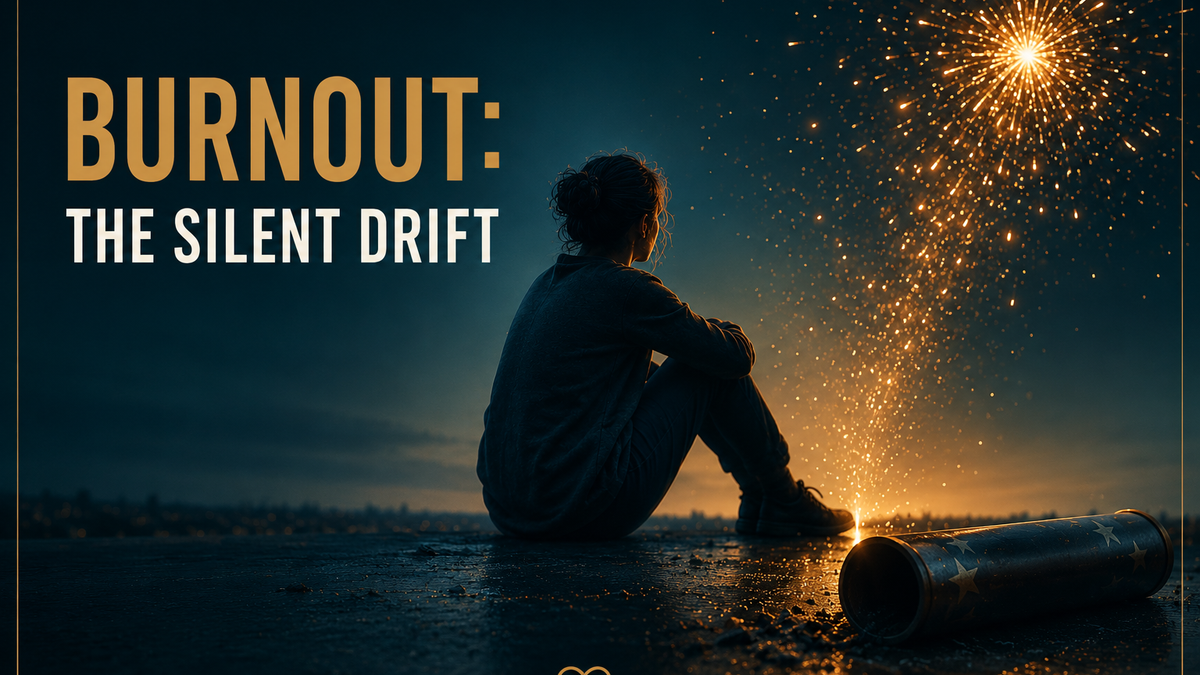
When did human beings become fireworks? It’s an odd question, I know, but stay with me. You light the fuse, stand back and enjoy the show. All that energy, colour, noise and brilliance lights up the sky and then, when it’s finished, you pick up what’s left and throw away the cartridge.
Job done.
Except we’re talking about human beings.
We find the ones who can cope, you know the people I mean, the dependable ones, the team players, the ones who don’t make too much noise when things get difficult, they just get on with it. And because they get on with it, we give them more. Which makes sense, doesn’t it? If you’ve got something important that needs doing, who do you give it to? The person who might do it or the person you know will?
So they get more, then a bit more and, well, they handled that, so perhaps they can take this as well. Until eventually they can’t.
And then we ask, what went wrong?
Maybe that’s the wrong question.
The dripping tap
I keep coming back to a dripping tap. One drip isn’t a problem, neither is the next, and after a while you don’t hear it anymore. The tap hasn’t stopped dripping. You’ve just stopped noticing.
Stay half an hour later. Answer one more email. Skip lunch because there’s a meeting. Check something before bed. Do a couple of hours on Sunday because things are particularly busy at the moment.
There’s a phrase, at the moment. How long is a moment? A day? A week? Six months? Three years? At some point “at the moment” just becomes how you live.
Which takes me, slightly sideways, to Covid.
Do you remember it? Of course you do. Except… do we? I mean, really? Six years, that’s all, and yet we seem to have taken one of the strangest periods in modern human history, put it in a box, shoved it onto a shelf and gone, right, what’s next?
I remember queuing outside a shop, everybody two metres apart, nobody really talking. It looked like some sort of apocalypse film. Eventually I got inside and so much of the food had gone. Shelves empty. And I remember the feeling. Not infection rates, supply chains or government policy. Just fear.
What the hell is happening?
Were people going to die? Were we going to die? Was this Armageddon?
You remember what that was like.
Then every evening we watched the news. Cases, hospitalisations, deaths. And at exactly the same time life was strangely normal. Well, normal-ish.
It was a hot summer. We’d managed to get one of those above-ground swimming pools everybody suddenly wanted, we’d got a puppy just before lockdown, and I had things to fix. Lots of things, actually. The house needed work, so I became the ultimate DIYer and at one point — this remains one of the highlights — I even had my own mini digger for a week.
Apparently, if you give me a mini digger, global catastrophe can wait because there’s earth to be moved.
I couldn’t control Covid, whether the shops had food or what somebody was going to announce at the next briefing. But I could fix that wall, repair that thing, dig a hole.
So I did.
And work carried on.
Before Covid, for lots of us, work had a physical boundary. You went to work, you worked, you came home. Obviously people worked from home before Covid, I’m not suggesting somebody invented the laptop in March 2020, but suddenly home was work.
And when you’re working at home, when exactly do you go home? You’re already there. The laptop is on the kitchen table, in the spare bedroom, six feet away on the sofa. There wasn’t anywhere much to go in the evening anyway, so six became seven, seven became eight and eight became… well, whenever.
Nobody decided to do it.
It just happened.
Let’s call her Lillian
Lillian was good at her job. Actually, no, that’s not quite it. Lots of people are good at their jobs.
Lillian was reliable.
When things got difficult, she stepped up. New technology? Learn it. Deadline slipping? Sort it. Somebody struggling? Help them. Work until seven? Okay. Eight? If that’s what it takes.
And people noticed. “Thank you. You’ve been amazing. I don’t know what we’d have done without you.”
Then came, “Could you just…?”
Of course she could. So she did.
And because she did, they asked again.
You don’t need some evil manager sitting in a darkened office plotting this stuff. Life isn’t a Bond film. Although let’s not be naive either, some organisations know exactly who will answer at seven, who won’t say no and who will quietly pick up what somebody else has dropped.
Lillian kept going. Work got longer, movement got less, her weight increased, her physical health deteriorated and tired became normal. And still she delivered, still people thanked her and still she coped. From the outside, you might even have called her successful.
And if you asked Lillian?
“It’s just busy at the moment. It’ll calm down. I just need to get through this bit. Other people have got it worse than me.”
None of those things sounded particularly unreasonable.
When exactly did the problem begin?
Then we talked about her nephew.
She adored him. She wanted to watch him grow up, to know the person he would become. Birthdays, Christmases, conversations, laughter, probably arguments — let’s not make the imaginary future too perfect.
Just life.
So we imagined him older. What does he look like? What are you talking about? What are you laughing about? And where are you in that picture?
Not watching it.
In it.
She already knew she should lose weight, work less, look after herself better. None of that was news.
But she’d never really considered that other people wanted her to be there. Not what she could do for them.
Her.
Her nephew wanted his aunt.
And suddenly there was a Christmas that hadn’t happened yet, a conversation they hadn’t had, and herself there.
That was enough to start something.
What about you?
You’ve probably recognised some of this. You know what it feels like.
We live in a world constantly reminding us what we can’t control. War, economies, governments, corporations, AI, technology. Things happening thousands of miles away arriving beside your bed before you’ve even got up.
Fine. You can’t fix all of that.
But when did that start to mean that you matter less?
There’s a thought from Carl Jung that stays with me. I can care for the sick, feed the hungry, forgive the most difficult of people. I can give all of that to somebody else.
You worked the extra hours. Rescued the deadline. Looked after everybody. Kept going.
Well done.
What about you?
Lillian needed her nephew before she began to see herself differently. She saw herself through somebody else’s eyes and realised that her presence mattered too.
So forget Lillian.
Forget your job title, what you earn, what you’ve achieved and how useful everybody thinks you are.
On a scale of one to ten, how much do you believe that you matter?
What’s the number?
If it isn’t ten:
Why not?
And:
What are you going to do about it?
Because noticing isn’t change.
And if you still don’t believe you’re worth looking after…
Welcome to becoming a firework.

Richard Elwell
Executive & Leadership Clarity Guide with over 20 years of experience helping leaders, teams, and individuals find quiet clarity.
Ready to find quiet clarity in your decisions?
Book a 1-on-1 guided clarity session with Richard Elwell using the visual card process.